Hellmann–Feynman theorem
| Part of a series of articles about |
| Quantum mechanics |
|---|
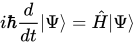
In quantum mechanics, the Hellmann–Feynman theorem relates the derivative of the total energy with respect to a parameter to the expectation value of the derivative of the Hamiltonian with respect to that same parameter. According to the theorem, once the spatial distribution of the electrons has been determined by solving the Schrödinger equation, all the forces in the system can be calculated using classical electrostatics.
The theorem has been proven independently by many authors, including Paul Güttinger (1932), Wolfgang Pauli (1933), Hans Hellmann (1937) and Richard Feynman (1939).
The theorem states
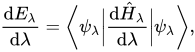
where
- is a Hermitian operator depending upon a continuous parameter
- , is an eigenstate (eigenfunction) of the Hamiltonian, depending implicitly upon
- is the energy (eigenvalue) of the state , i.e.



Note that for systems with degenerate states, a refined version of the Hellmann–Feynman theorem is needed.