Quantum nonlocality
| Part of a series of articles about |
| Quantum mechanics |
|---|
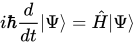
In theoretical physics, quantum nonlocality refers to the phenomenon by which the measurement statistics of a multipartite quantum system do not allow an interpretation with local hidden variables. Quantum nonlocality has been experimentally verified under a variety of physical assumptions, except for the many-worlds interpretation which violates an assumption of Bell's theorem.
Quantum nonlocality does not allow for faster-than-light communication, and hence is compatible with special relativity and its universal speed limit of objects. Thus, quantum theory is local in the strict sense defined by special relativity and, as such, the term "quantum nonlocality" is sometimes considered a misnomer. Still, it prompts many of the foundational discussions concerning quantum theory.