Runge's theorem
In complex analysis, Runge's theorem (also known as Runge's approximation theorem) is named after the German mathematician Carl Runge who first proved it in 1885. It states the following:
Denoting by C the set of complex numbers, let K be a closed subset of and let f be a function which is holomorphic on an open set containing K. If A is a set containing at least one complex number from every connected component of , then there exists a sequence of rational functions which converges uniformly to f on K and such that all the poles of the functions are in A.

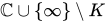

Note that not every complex number in A needs to be a pole of every rational function of the sequence . We merely know that for all members of that do have poles, those poles lie in A.
One aspect that makes this theorem so powerful is that one can choose the set A arbitrarily. In other words, one can choose any complex numbers from the bounded connected components of and the theorem guarantees the existence of a sequence of rational functions with poles only amongst those chosen numbers.
For the special case in which K is a compact subset of and is a connected set one can pick . Since rational functions with no poles except at infinity are simply polynomials, we get the following corollary: If K is a compact subset of C such that C\K is a connected set, and f is a holomorphic function on an open set containing K, then there exists a sequence of polynomials that approaches f uniformly on K.


