Uniform convergence
In the mathematical field of analysis, uniform convergence is a mode of convergence of functions stronger than pointwise convergence. A sequence of functions converges uniformly to a limiting function on a set as the function domain if, given any arbitrarily small positive number , a number can be found such that each of the functions differs from by no more than at every point in . That is, the required value of only depends on not on any particular .





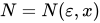
By contrast, pointwise convergence of to merely guarantees that given any , we can find (that is, possibly depending on as well as ) such that for the specific value of given, falls within of whenever A different may require a larger value of



The difference between uniform convergence and pointwise convergence was not fully appreciated early in the history of calculus, leading to instances of faulty reasoning. The concept, which was first formalized by Karl Weierstrass, is important because several properties of the functions , such as continuity, Riemann integrability, and, with additional hypotheses, differentiability, are transferred to the limit if the convergence is uniform, but not necessarily if the convergence is not uniform.
