Observer effect (physics)
| Part of a series of articles about |
| Quantum mechanics |
|---|
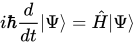
In physics, the observer effect is the disturbance of a system by the act of observation. This is often the result of utilising instruments that, by necessity, alter the state of what they measure in some manner. A common example is checking the pressure in an automobile tire, which causes some of the air to escape, thereby changing the amount of pressure one observes. Similarly, seeing non-luminous objects requires light hitting the object to cause it to reflect that light. While the effects of observation are often negligible, the object still experiences a change. This effect can be found in many domains of physics, but can usually be reduced to insignificance by using various instruments or observation techniques.
A notable example of the observer effect occurs in quantum mechanics, as demonstrated by the double-slit experiment. Physicists have found that observation of quantum phenomena by a detector or an instrument can change the measured results of this experiment. Despite the "observer effect" in the double-slit experiment being caused by the presence of an electronic detector, the experiment's results have been interpreted by some to suggest that a conscious mind can directly affect reality. However, the need for the "observer" to be conscious is not supported by scientific research, and has been pointed out as a misconception rooted in a poor understanding of the quantum wave function ψ and the quantum measurement process.