| Weibull (2-parameter) |
|---|
|
Probability density function |
|
Cumulative distribution function |
| Parameters |
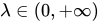 scale scale
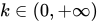 shape shape |
|---|
| Support |
 |
|---|
| PDF |
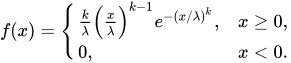 |
|---|
| CDF |
 |
|---|
| Quantile |
 |
|---|
| Mean |
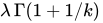 |
|---|
| Median |
 |
|---|
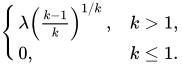
| Mode |
 |
|---|
| Variance |
![{\displaystyle \lambda ^{2}\left[\Gamma \left(1+{\frac {2}{k}}\right)-\left(\Gamma \left(1+{\frac {1}{k}}\right)\right)^{2}\right]\,}](./_assets_/eb734a37dd21ce173a46342d1cc64c92/55fa6b5cdbe81bb9e6aa0452a2c619623cb23f14.svg) |
|---|
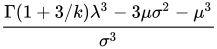
| Skewness |
 |
|---|
| Excess kurtosis |
(see text) |
|---|
| Entropy |
 |
|---|
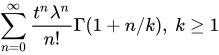
| MGF |
 |
|---|
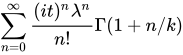
| CF |
 |
|---|
| Kullback–Leibler divergence |
see below |
|---|
Preview warning: Page using Template:Infobox probability distribution with unknown parameter "ES"
In probability theory and statistics, the Weibull distribution is a continuous probability distribution. It models a broad range of random variables, largely in the nature of a time to failure or time between events. Examples are maximum one-day rainfalls and the time a user spends on a web page.
The distribution is named after Swedish mathematician Waloddi Weibull, who described it in detail in 1939, although it was first identified by René Maurice Fréchet and first applied by Rosin & Rammler (1933) to describe a particle size distribution.