Walras's law
Walras's law is a fundamental principle in general equilibrium theory that establishes a mathematical relationship between market supply and demand across an entire economy. The law asserts that because all economic agents face budget constraints, the total value of excess demand across all markets must equal the total value of excess supply—meaning these values sum to zero. This relationship holds regardless of whether the prevailing prices represent general equilibrium prices. This relationship holds even when individual markets may be in disequilibrium.
The economic intuition underlying Walras's law stems from the fact that all economic agents—consumers, firms, and governments—face budget constraints that limit their total expenditures to their available income and wealth. When these individual constraints are aggregated across all agents and markets, they create a system-wide accounting identity: if one market has excess demand (shortage), other markets must have offsetting excess supply (surplus) of equivalent value.
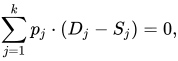
Mathematically, Walras's law is expressed as:
where is the price of good j, and and represent the aggregate demand and supply respectively of good j across all k markets in the economy.