Inverse Gaussian distribution
| Inverse Gaussian | |||
|---|---|---|---|
|
Probability density function | |||
|
Cumulative distribution function | |||
| Notation | |||
| Parameters |
| ||
| Support | |||
| CDF |
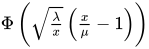
where is the standard normal (standard Gaussian) distribution c.d.f. | ||
| Mean |
| ||
| Mode | |||
| Variance |
| ||
| Skewness | |||
| Excess kurtosis | |||
| MGF | |||
| CF | |||


![{\displaystyle \textstyle {\sqrt {\frac {\lambda }{2\pi x^{3}}}}\exp \left[-{\frac {\lambda (x-\mu )^{2}}{2\mu ^{2}x}}\right]}](./_assets_/eb734a37dd21ce173a46342d1cc64c92/7a9067152185f20239ba2448eb20e18b434c0169.svg)


![{\displaystyle \textstyle \operatorname {E} [X]=\mu }](./_assets_/eb734a37dd21ce173a46342d1cc64c92/065630d3bd45fc185b5759ffa0fd441c332e35bf.svg)
![{\displaystyle \textstyle \operatorname {E} \left[{\frac {1}{X}}\right]={\frac {1}{\mu }}+{\frac {1}{\lambda }}}](./_assets_/eb734a37dd21ce173a46342d1cc64c92/391b6ef9d4bcf403eeaa5f024e8b44f9471af7f7.svg)
![{\displaystyle \textstyle \mu \left[\left(1+{\frac {9\mu ^{2}}{4\lambda ^{2}}}\right)^{\frac {1}{2}}-{\frac {3\mu }{2\lambda }}\right]}](./_assets_/eb734a37dd21ce173a46342d1cc64c92/dc12e6d4db299832b9784a16de35320579936c5c.svg)
![{\displaystyle \textstyle \operatorname {Var} [X]={\frac {\mu ^{3}}{\lambda }}}](./_assets_/eb734a37dd21ce173a46342d1cc64c92/bb836f0743e16d06cf96cfe54cb2b16306c7b463.svg)
![{\displaystyle \textstyle \operatorname {Var} \left[{\frac {1}{X}}\right]={\frac {1}{\mu \lambda }}+{\frac {2}{\lambda ^{2}}}}](./_assets_/eb734a37dd21ce173a46342d1cc64c92/acfb18aed4c1ea2c189da467eb35110d4e528b23.svg)


![{\displaystyle \textstyle \exp \left[{{\frac {\lambda }{\mu }}\left(1-{\sqrt {1-{\frac {2\mu ^{2}t}{\lambda }}}}\right)}\right]}](./_assets_/eb734a37dd21ce173a46342d1cc64c92/7b89a568f9310640ebc3518af4ef8ac59252aa9b.svg)
![{\displaystyle \textstyle \exp \left[{{\frac {\lambda }{\mu }}\left(1-{\sqrt {1-{\frac {2\mu ^{2}\mathrm {i} t}{\lambda }}}}\right)}\right]}](./_assets_/eb734a37dd21ce173a46342d1cc64c92/c84cee74b386e37a4765492d0c04c1cf4480a9dd.svg)
In probability theory, the inverse Gaussian distribution (also known as the Wald distribution) is a two-parameter family of continuous probability distributions with support on .

Its probability density function is given by

for , where is the mean and is a shape parameter. Either or (or more generally any combination of the form for any real ) can serve as a scale parameter, so a proper (i.e., unscaled) shape parameter would be any non-zero power of : Tweedie proposed to use the and parametrizations in addition to the standard parametrization (“Each of these forms is convenient or suggestive for some purpose.”), and later on uses exclusively the parametrization.


The inverse Gaussian distribution has several properties analogous to a Gaussian distribution. The name can be misleading: it is an inverse only in that, while the Gaussian describes a Brownian motion's level at a fixed time, the inverse Gaussian describes the distribution of the time a Brownian motion with positive drift takes to reach a fixed positive level. The relationship between the Gaussian and inverse Gaussian distributions is thus the same as the relationship between the binomial (number of successes for a fixed number of Bernoulli trials) and negative binomial (number of Bernoulli trials for a fixed number of successes) distributions.
The y-axis reflections of the cumulant generating functions of the Gaussian and inverse Gaussian distributions are inverse of each other (i.e., the graphs of the two cumulant generating functions are reflections of each other across the line ), a property that is also shared between the binomial and negative binomial distributions (after dividing their cumulant generating functions by their respective fixed parameter).

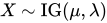
To indicate that a random variable is inverse Gaussian-distributed with mean and shape parameter we write .