First uncountable ordinal
In mathematics, the first uncountable ordinal, traditionally denoted by or sometimes by , is the smallest ordinal number that is the order type of a uncountable well-ordered set. It is the supremum (least upper bound) of all countable ordinals. In the von Neumann representation, the elements of are the countable ordinals (including finite ordinals), of which there are uncountably many.


The cardinality of the set is the first uncountable cardinal number, (aleph-one). The ordinal is thus the initial ordinal of . Like all other initial ordinals of infinite cardinals, is a limit ordinal, i.e. there is no ordinal such that . Formally, cardinal numbers are usually represented as their initial ordinals, in which case and are considered equal as sets. More generally, for any ordinal , denotes the initial ordinal of the cardinal .


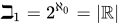
The continuum hypothesis (CH) states that (where is the second beth number), which implies that , i.e., the countable ordinals are equinumerous to the real numbers. If CH does not hold, but the axiom of choice (AC) does, then , as the smallest uncountable cardinal, is strictly less than . If AC also does not hold then may be incomparable with , but never larger than .



The existence of does not depend on AC, as it can be constructed explicitly as the Hartogs number of . More concretely, the set of all well-orderings on can be constructed as a subset of all binary relations on , and thus applying the axiom of replacement to replace every well-ordering with its order type will give .

