Sinc function
| Sinc | |
|---|---|
Part of the normalized sinc (blue) and unnormalized sinc function (red) shown on the same scale | |
| General information | |
| General definition | |
| Fields of application | Signal processing, spectroscopy |
| Domain, codomain and image | |
| Domain | |
| Image | |
| Basic features | |
| Parity | Even |
| Specific values | |
| At zero | 1 |
| Value at +∞ | 0 |
| Value at −∞ | 0 |
| Maxima | 1 at |
| Minima | at |
| Specific features | |
| Root | |
| Related functions | |
| Reciprocal | |
| Derivative | |
| Antiderivative | |
| Series definition | |
| Taylor series | |

![{\displaystyle [-0.217234\ldots ,1]}](./_assets_/eb734a37dd21ce173a46342d1cc64c92/8f0d3c8e779da502016a1259f426cdfb7aa130cf.svg)




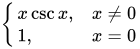
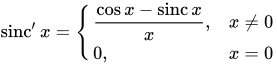
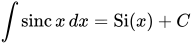
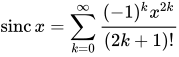
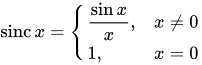
In mathematics, physics and engineering, the sinc function (/ˈsɪŋk/ SINK), denoted by sinc(x), is defined as either or
the latter of which is sometimes referred to as the normalized sinc function. The only difference between the two definitions is in the scaling of the independent variable (the x axis) by a factor of π. In both cases, the value of the function at the removable singularity at zero is understood to be the limit value 1. The sinc function is then analytic everywhere and hence an entire function.
The normalized sinc function is the Fourier transform of the rectangular function with no scaling. It is used in the concept of reconstructing a continuous bandlimited signal from uniformly spaced samples of that signal. The sinc filter is used in signal processing.
The function itself was first mathematically derived in this form by Lord Rayleigh in his expression (Rayleigh's formula) for the zeroth-order spherical Bessel function of the first kind.
The sinc function is also called the cardinal sine function.