Rule of mixtures
In materials science, a general rule of mixtures is a weighted mean used to predict various properties of a composite material . It provides a theoretical upper- and lower-bound on properties such as the elastic modulus, thermal conductivity, and electrical conductivity.
In general there are two models. The rule of mixtures (the Voigt model) is derived under the assumption that the strain in both constituents is equal. The inverse rule of mixtures (the Reuss model) is found if the stress in both constituents is assumed equal. Respectively, these could model axial- and transverse loading in a fiber-reinforced composite material.
For the Young's modulus , the rule of mixtures states that the overall modulus equals

- .

The inverse rule of mixtures states that Young's modulus equals
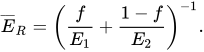
where
- is the volume fraction of the first constituent
- are the stiffness of constituents 1 and 2 respectively
- are the stiffnesses homogenized according to the Voigt and Reuss assumptions respectively
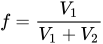


These two moduli are often treated as an upper- and lower bound, with the actual modulus lying somewhere inbetween.