Riffle shuffle permutation
In the mathematics of permutations and the study of shuffling playing cards, a riffle shuffle permutation is a permutation of a set of ordered items that can be obtained by a single riffle shuffle, in which a sorted deck of cards (increasing top-to-bottom) is cut into two packets and then the two packets are interleaved (e.g. by moving cards one at a time from the bottom of one or the other of the packets to the top of the sorted deck). As a special case of this, a -shuffle, for numbers and with , is a riffle in which the first packet has cards and the second packet has cards.


Considering a permutation as a bijective function from the set to itself, a riffle shuffle is defined as containing only 1 or 2 maximal rising sequences, meaning can be decomposed into two disjoint subsets and with


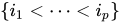

and .


A permutation with only 1 maximal rising sequence is the identity permutation.
The inverse permutation of a riffle shuffle is known as Grassmannian permutation, defined by


having one descent , or zero descents if is the identity. In Schubert calculus, these index Schubert varieties in a Grassmannian space.


A permutation which is both a riffle shuffle and Grassmannian (i.e. both and its inverse are Grassmannian, or equivalently both are riffle shuffles), is called bigrassmannian or an invertible shuffle.