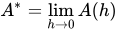
Richardson extrapolation
In numerical analysis, Richardson extrapolation is a method used to estimate some value if the truncation error is known to have a (possibly 1-sided) power-series expansion at . The method is most often applied as a sequence acceleration method to improve the rate of convergence of iterative methods. It is named after Lewis Fry Richardson, who introduced the technique in the early 20th century, though a form of the idea was already known to Christiaan Huygens in the 17th century and used his calculation of . Practical applications of Richardson extrapolation include Romberg integration, which applies Richardson extrapolation to the trapezoid rule, and the Bulirsch–Stoer algorithm for solving ordinary differential equations. In the words of Birkhoff and Rota, "its usefulness for practical computations can hardly be overestimated."