Preorder
| Transitive binary relations | ||||||||||||||||||||||||||||||||||||||||||||||||||||||||||||||||||||||||||||||||||||||||||||||||||||||||||||||||||||||||||||||||||||||||||||||||||||||||||||||||||||||||||||||||||||
|---|---|---|---|---|---|---|---|---|---|---|---|---|---|---|---|---|---|---|---|---|---|---|---|---|---|---|---|---|---|---|---|---|---|---|---|---|---|---|---|---|---|---|---|---|---|---|---|---|---|---|---|---|---|---|---|---|---|---|---|---|---|---|---|---|---|---|---|---|---|---|---|---|---|---|---|---|---|---|---|---|---|---|---|---|---|---|---|---|---|---|---|---|---|---|---|---|---|---|---|---|---|---|---|---|---|---|---|---|---|---|---|---|---|---|---|---|---|---|---|---|---|---|---|---|---|---|---|---|---|---|---|---|---|---|---|---|---|---|---|---|---|---|---|---|---|---|---|---|---|---|---|---|---|---|---|---|---|---|---|---|---|---|---|---|---|---|---|---|---|---|---|---|---|---|---|---|---|---|---|---|
| ||||||||||||||||||||||||||||||||||||||||||||||||||||||||||||||||||||||||||||||||||||||||||||||||||||||||||||||||||||||||||||||||||||||||||||||||||||||||||||||||||||||||||||||||||||
| indicates that the column's property is always true for the row's term (at the very left), while ✗ indicates that the property is not guaranteed in general (it might, or might not, hold). For example, that every equivalence relation is symmetric, but not necessarily antisymmetric, is indicated by in the "Symmetric" column and ✗ in the "Antisymmetric" column, respectively. All definitions tacitly require the homogeneous relation be transitive: for all if and then |


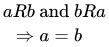


In mathematics, especially in order theory, a preorder or quasiorder is a binary relation that is reflexive and transitive. The name preorder is meant to suggest that preorders are almost partial orders, but not quite, as they are not necessarily antisymmetric.
A natural example of a preorder is the divides relation "x divides y" between integers. This relation is reflexive as every integer divides itself. It is also transitive. But it is not antisymmetric, because e.g. divides and divides , but is not equal to . It is to this preorder that "least" refers in the phrase "least common multiple" (in contrast, using the natural order on integers, e.g. and have the common multiples , , , , , ..., but no least one).


Preorders are closely related to equivalence relations and (non-strict) partial orders. Both of these are special cases of a preorder: an antisymmetric preorder is a partial order, and a symmetric preorder is an equivalence relation. Moreover, a preorder on a set can equivalently be defined as an equivalence relation on , together with a partial order on the set of equivalence class, cf. picture. Like partial orders and equivalence relations, preorders (on a nonempty set) are never asymmetric.

A preorder can be visualized as a directed graph, with elements of the set corresponding to vertices, and the order relation between pairs of elements corresponding to the directed edges between vertices. The converse is not true: most directed graphs are neither reflexive nor transitive. A preorder that is antisymmetric no longer has cycles; it is a partial order, and corresponds to a directed acyclic graph. A preorder that is symmetric is an equivalence relation; it can be thought of as having lost the direction markers on the edges of the graph. In general, a preorder's corresponding directed graph may have many disconnected components.
A preorder is often denoted or .

