Project 8 (physics experiment)
| Active years | 2009 – present |
|---|---|
| Phases | |
| Phase I | Completed |
| Phase II | Completed |
| Phase III | In progress |
| Phase IV | Planned |
| Sponsors | |
| U.S. Department of Energy (Office of Science, Office of Nuclear Physics), National Science Foundation, University of Mainz PRISMA+ Cluster of Excellence | |
| Involved countries | |
| United States, Germany, Belgium | |
| Involved institutes | |
| Yale University, University of Washington, University of Texas at Arlington, University of Pittsburgh, Pennsylvania State University, Pacific Northwest National Laboratory, Massachusetts Institute of Technology, Lawrence Livermore National Laboratory, Lawrence Berkeley National Laboratory, Karlsruhe Institute of Technology, Johannes Gutenberg University Mainz, Indiana University, University of Illinois Urbana-Champaign, Case Western Reserve University, Carnegie Mellon University, Ghent University, Colorado School of Mines | |
The Project 8 experiment is an ongoing neutrino mass physics experiment. Project 8 also refers to the international collaboration carrying out the experiment.
In 2009, Benjamin Monreal and Joseph A. Formaggio proposed that single electrons moving in a magnetic field could be detected via their emission of cyclotron radiation. The frequency of this radiation depends on the relativistic mass of the electron, the sum of the rest mass and the kinetic energy divided by . This approach would therefore allow a frequency-based determination of an electron's kinetic energy, a new method in spectroscopy called Cyclotron Radiation Emission Spectroscopy (CRES) . The Project 8 collaboration formed to test this concept experimentally and achieved success in an experiment at the University of Washington in 2015.

The main motivation for this initiative was the measurement of the neutrino masses, specifically the absolute rest mass of the electron antineutrino using Cyclotron Radiation Emission Spectroscopy (CRES). Electrons emitted in beta decay are accompanied by neutrinos (strictly, antineutrinos, which still remain an open question whether or not they are the same as neutrinos). The neutrino emitted, a flavor state called the electron neutrino, is a linear superposition of three particles with tiny, slightly different, masses. The differences between the squares of those masses are known from neutrino oscillation experiments, but the absolute mass values are not yet known. The effective mass of the linear superposition is, for convenience, termed the mass of the electron neutrino.
The most sensitive experiments so far all use the beta decay of tritium and search for a modification of the continuous beta spectrum near the endpoint (maximum electron energy). Neutrino rest mass reduces the maximum electron kinetic energy, causing a change in the shape of the spectrum compared to the case with massless neutrinos. The KATRIN experiment has achieved the most sensitive upper limit on the mass to date, . Project 8 intends to use CRES for a sensitive measurement, ultimately in Phase IV to a limit of , if not a mass determination. Neutrino oscillations do not determine the mass but do set a lower limit on the mass of or , depending on the unknown ordering of the 3 masses.


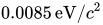

The collaboration has reported peer-reviewed experimental results in Phases I and II and is currently pursuing Phase III research and development. A future Phase IV is planned with the goal of improving sensitivity to meV.
