Phonological opacity
| Part of a series on |
| Linguistics |
|---|
| Portal |
Phonological opacity is a phenomenon in phonology. Opacity exists when a phonological rule that exists in a given language appears to be contradicted by the surface structure (i.e., actual pronunciation) of words in the language. Opacity is a property of a certain surface structure, rather than a specific rule. The term was first defined by Kiparsky in the following way:
A phonological rule P, , is opaque if one of the following surface structures exists:
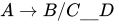
- instance of A in the environment;
- instance of B created by P in an environment other than ;

Although we sometimes talk of opaque rules, a rule by itself is not opaque, it is the interaction between two rules that creates an opaque surface form (i.e., it becomes difficult to understand which rules were applied and how these rules interacted).