Pearson's chi-squared test
Pearson's chi-squared test or Pearson's test is a statistical test applied to sets of categorical data to evaluate how likely it is that any observed difference between the sets arose by chance. It is the most widely used of many chi-squared tests (e.g., Yates, likelihood ratio, portmanteau test in time series, etc.) – statistical procedures whose results are evaluated by reference to the chi-squared distribution. Its properties were first investigated by Karl Pearson in 1900. In contexts where it is important to improve a distinction between the test statistic and its distribution, names similar to Pearson χ-squared test or statistic are used. It is a p-value test.

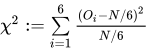
A simple example is testing the hypothesis that an ordinary six-sided die is "fair" (i. e., all six outcomes are equally likely to occur). In this case, the observed data is , the number of times that the die has fallen on each number. The null hypothesis is , and . As detailed below, if , then the fairness of the die can be rejected at the level of .