Paradoxes of material implication
The paradoxes of material implication are a group of classically true formulae involving material conditionals whose translations into natural language are intuitively false when the conditional is translated with English words such as "implies" or "if ... then ...". They are sometimes phrased as arguments, since they are easily turned into arguments with modus ponens: if it is true that "if then " (), then from that together with , one may argue for . Among them are the following:


| Propositional formula | Paraphrase in English, with example | Names in the literature |
|---|---|---|
| "If P, then if Q, then P"; a true proposition is implied by any other proposition. For instance, it is a valid argument that "there is no integer n greater than or equal to 3 such that for some positive integers x,y,z, xn = yn + zn. Therefore, if the sky is blue, then there is no integer n greater than or equal to 3 such that for some positive integers x,y,z, xn = yn + zn." | positive paradox | |
| "If P, then Q or not Q" (a particular case of the above); a disjunction between a proposition and its negation, since it is a classical tautology, is implied by anything. For instance, this proposition is considered classically true: "If The moon is made of green cheese, either it is raining in Ecuador now or it is not." So is this one: "If my dog barks at rubbish collectors, then either it is raining in Bolivia right now or it is not." | No common names in the literature. It is also a paradox of strict implication. | |
| "If it is not the case that P, then if P, then Q"; a false proposition implies any other. For instance, if Socrates was not a solar myth, then "Socrates was a solar myth" implies 2+2=5. Or, given that the moon is not made of cheese, then it is true that "if the moon is made of cheese, it is made of ketchup". | vacuous truth | |
| "If it is the case that P and it is not the case that P, then it is the case that Q"; anything follows from a contradiction. For instance, it is a valid argument that "If Pat is both a mother and not a mother, then Pat is a father". | principle of explosion, or paradox of entailment. It is also a paradox of strict implication. | |
| "Either if P then Q, or if Q then R, or both"; a proposition is either implied by any other (which happens when it is true) or implies any other (which happens when it is false). For example, it is a tautologically true proposition that "either the fact that this article was edited by a Brazilian implies that it is accurate, or this article's accuracy implies that it was edited by an Englishman". | No common names in the literature. | |
| "Either if P then Q, or if Q then P, or both" (a particular case of the above); of two propositions, either the first implies the second, or the second implies the first. For example, it is a tautologically true proposition that "either the Continuum Hypothesis implies the Collatz Conjecture, or the Collatz Conjecture implies the Continuum Hypothesis". | No common names in the literature. |
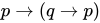
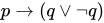
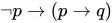
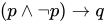


Russell's definition of "p implies q" as synonymous with "either not p or q" solicited the justified objection that according to it a true proposition is implied by any proposition and a false proposition implies any proposition (paradoxes of material implication).
A material conditional formula is true unless is true and is false; it is synonymous with "either P is false, or Q is true, or both". This gives rise to vacuous truths such as, "if 2+2=5, then this Wikipedia article is accurate", which is true regardless of the contents of this article, because the antecedent is false. Given that such problematic consequences follow from an extremely popular and widely accepted model of reasoning, namely the material implication in classical logic, they are called paradoxes. They demonstrate a mismatch between classical logic and robust intuitions about meaning and reasoning.