Nth root
In mathematics, an nth root of a number is the number r which, when multiplied by itself n times, yields x: The positive integer n is called the index or degree, and the number x of which the root is taken is the radicand. A root of degree 2 is called a square root and a root of degree 3, a cube root. Roots of higher degree are referred by using ordinal numbers, as in fourth root, twentieth root, etc. The computation of an nth root is a root extraction.
The nth root of x is written as using the radical symbol . The square root is usually written as , with the degree omitted. Taking the nth root of a number, for fixed , is the inverse of raising a number to the nth power, and can be written as a fractional exponent:
![{\displaystyle {\sqrt[{n}]{x}}}](./_assets_/eb734a37dd21ce173a46342d1cc64c92/7b3ba2638d05cd9ed8dafae7e34986399e48ea99.svg)


For a positive real number x, denotes the positive square root of x and denotes the positive real nth root. For example, 3 is a square root of 9, since 32 = 9, and −3 is also a square root of 9, since (−3)2 = 9. A negative real number −x has no real-valued square roots, but when x is treated as a complex number it has two imaginary square roots, and , where i is the imaginary unit.


In general, any non-zero complex number has n distinct complex-valued nth roots, equally distributed around a complex circle of constant absolute value. (The nth root of 0 is zero with multiplicity n, and this circle degenerates to a point.) Extracting the nth roots of a complex number x can thus be taken to be a multivalued function. By convention the principal value of this function, called the principal root and denoted , is taken to be the nth root with the greatest real part and in the special case when x is a negative real number, the one with a positive imaginary part. The principal root of a positive real number is thus also a positive real number. As a function, the principal root is continuous in the whole complex plane, except along the negative real axis. The nth roots of 1 are called roots of unity and play a fundamental role in various areas of mathematics, such as number theory, theory of equations, and Fourier transform.
An unresolved root, especially one using the radical symbol, is sometimes referred to as a surd or a radical. Any expression containing a radical, whether it is a square root, a cube root, or a higher root, is called a radical expression, and if it contains no transcendental functions or transcendental numbers it is called an algebraic expression.
| Arithmetic operations | ||||||||||||||||||||||||||||||||||||||||||
|
||||||||||||||||||||||||||||||||||||||||||
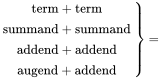

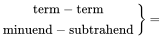

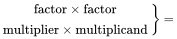

![{\displaystyle \scriptstyle \left.{\begin{matrix}\scriptstyle {\frac {\scriptstyle {\text{dividend}}}{\scriptstyle {\text{divisor}}}}\\[1ex]\scriptstyle {\frac {\scriptstyle {\text{numerator}}}{\scriptstyle {\text{denominator}}}}\end{matrix}}\right\}\,=\,}](./_assets_/eb734a37dd21ce173a46342d1cc64c92/5d5d22ff59234f0d437be740306e8dd905991e1e.svg)

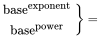

![{\displaystyle \scriptstyle {\sqrt[{\text{degree}}]{\scriptstyle {\text{radicand}}}}\,=\,}](./_assets_/eb734a37dd21ce173a46342d1cc64c92/5582d567e7e7fbcdb728291770905e09beb0ea18.svg)


