Myers's theorem
Myers's theorem, also known as the Bonnet–Myers theorem, is a celebrated, fundamental theorem in the mathematical field of Riemannian geometry. It was discovered by Sumner Byron Myers in 1941. It asserts the following:
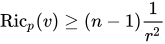
Let be a complete and connected Riemannian manifold of dimension whose Ricci curvature satisfies for some fixed positive real number the inequality for every and of unit length. Then any two points of can be joined by a geodesic segment of length at most .




In the special case of surfaces, this result was proved by Ossian Bonnet in 1855. For a surface, the Gauss, sectional, and Ricci curvatures are all the same, but Bonnet's proof easily generalizes to higher dimensions if one assumes a positive lower bound on the sectional curvature. Myers' key contribution was therefore to show that a Ricci lower bound is all that is needed to reach the same conclusion.