Multiscale modeling
Multiscale modeling or multiscale mathematics is the field of solving problems that have important features at multiple scales of time and/or space. Important problems include multiscale modeling of fluids, solids, polymers, proteins, nucleic acids as well as various physical and chemical phenomena (like adsorption, chemical reactions, diffusion). Statistical modeling techniques are increasingly integrated into multiscale modeling frameworks to bridge information between scales and quantify uncertainty. These approaches allow researchers to combine atomistic, mesoscale, and continuum data using probabilistic methods, improving predictive accuracy in complex systems.
An example of such problems involve the Navier–Stokes equations for incompressible fluid flow.
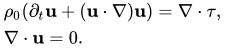
In a wide variety of applications, the stress tensor is given as a linear function of the gradient . Such a choice for has been proven to be sufficient for describing the dynamics of a broad range of fluids. However, its use for more complex fluids such as polymers is dubious. In such a case, it may be necessary to use multiscale modeling to accurately model the system such that the stress tensor can be extracted without requiring the computational cost of a full microscale simulation.

