Monge array
In mathematics applied to computer science, Monge arrays, or Monge matrices, are mathematical objects named for their discoverer, the French mathematician Gaspard Monge.
An m-by-n matrix is said to be a Monge array if, for all such that one obtains In other words, for any two rows and two columns of a Monge array, the four elements at the intersection points (a 2 × 2 sub-matrix) have the property that the sum of the upper-left and lower-right elements (on the main diagonal) is less than or equal to the sum of the lower-left and upper-right elements (on the antidiagonal).

This matrix is a Monge array:
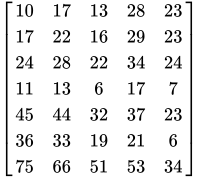
For example, take the intersection of rows 2 and 4 with columns 1 and 5. The four elements are The sum of the upper-left and lower-right elements (17 + 7 = 24) is not larger than the sum of the lower-left and upper-right elements (23 + 11 = 34).