Modulation spaces are a family of Banach spaces defined by the behavior of the short-time Fourier transform with
respect to a test function from the Schwartz space. They were originally proposed by Hans Georg Feichtinger and are recognized to be the right kind of function spaces for time-frequency analysis. Feichtinger's algebra, while originally introduced as a new Segal algebra, is identical to a certain modulation space and has become a widely used space of test functions for time-frequency analysis.
Modulation spaces are defined as follows. For  , a non-negative function
  on
on  and a test function
  , the modulation space
  is defined by

In the above equation,  denotes the short-time Fourier transform of
  with respect to
  evaluated at
  , namely

In other words, 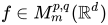 is equivalent to
 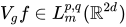 . The space is the same, independent of the test function chosen. The canonical choice is a Gaussian.
We also have a Besov-type definition of modulation spaces as follows.
 ,
,
where  is a suitable unity partition. If
  , then
  .
.