Michaelis–Menten kinetics
In biochemistry, Michaelis–Menten kinetics, named after Leonor Michaelis and Maud Menten, is the simplest case of enzyme kinetics, applied to enzyme-catalysed reactions involving the transformation of one substrate into one product. In 1913, Michaelis and Menten expanded on Victor Henri's fundamental equation of enzyme kinetics, which was established in 1902. It takes the form of a differential equation describing the reaction rate (rate of formation of product P, with concentration ) as a function of , the concentration of the substrate A (using the symbols recommended by the IUBMB). The formula below is given by the Michaelis–Menten equation:


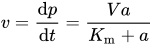
, which is often written as , represents the limiting rate approached by the system at saturating substrate concentration for a given enzyme concentration. The Michaelis constant has units of concentration, and for a given reaction is equal to the concentration of substrate at which the reaction rate is half of . Biochemical reactions involving a single substrate are often assumed to follow Michaelis–Menten kinetics, without regard to the model's underlying assumptions. Only a small proportion of enzyme-catalysed reactions have just one substrate, but the equation still often applies if only one substrate concentration is varied.


