Logical connective
| Logical connectives | ||||||||||||||||||||||||||
|---|---|---|---|---|---|---|---|---|---|---|---|---|---|---|---|---|---|---|---|---|---|---|---|---|---|---|
|
||||||||||||||||||||||||||
| Related concepts | ||||||||||||||||||||||||||
| Applications | ||||||||||||||||||||||||||
| Category | ||||||||||||||||||||||||||
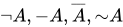




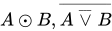

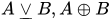





In logic, a logical connective (also called a logical operator, sentential connective, or sentential operator) is an operator that combines or modifies one or more logical variables or formulas, similarly to how arithmetic connectives like and combine or negate arithmetic expressions. For instance, in the syntax of propositional logic, the binary connective (meaning "or") can be used to join the two logical formulas and , producing the complex formula .


Unlike in algebra, there are many symbols in use for each logical connective. The table "Logical connectives" shows examples.
Common connectives include negation, disjunction, conjunction, implication, and equivalence. In standard systems of classical logic, these connectives are interpreted as truth functions, though they receive a variety of alternative interpretations in nonclassical logics. Their classical interpretations are similar to the meanings of natural language expressions such as English "not", "or", "and", and "if", but not identical. Discrepancies between natural language connectives and those of classical logic have motivated nonclassical approaches to natural language meaning.