Liouville's equation
- For Liouville's equation in dynamical systems, see Liouville's theorem (Hamiltonian).
- For Liouville's equation in quantum mechanics, see Von Neumann equation.
- For Liouville's equation in Euclidean space, see Liouville–Bratu–Gelfand equation.
Liouville's equation, named after Joseph Liouville, is a nonlinear partial differential equation that arises in differential geometry when studying surfaces of constant curvature. It plays a central role in the theory of conformal geometry, where one seeks to understand how a curved surface can be represented in flat (Euclidean) coordinates while preserving angles.
Suppose a surface is described in local coordinates , and we wish to assign it a Riemannian metric that has constant Gaussian curvature . A particularly useful form of such a metric is , where the function determines the local scaling of lengths. The equation satisfied by this conformal factor is called Liouville's equation:






where is the flat Laplace operator in two dimensions.
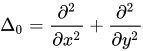
This equation governs how to deform flat space to give it constant curvature. For example, when , it describes spherical geometry; when , hyperbolic geometry. The function tells how much the flat metric must be stretched or shrunk at each point to reflect this curvature.


Liouville's equation is closely tied to the use of isothermal coordinates, in which the metric takes a conformally flat form. It also appears in complex analysis, as the conformal factor can be expressed using Wirtinger derivatives:
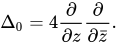
A logarithmic change of variable, , gives a more commonly used form of the equation:

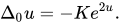
Liouville's equation also features in mathematical physics (e.g., in models of 2D gravity) and was cited by David Hilbert in his formulation of the nineteenth problem, concerning the smoothness of solutions to certain elliptic PDEs.