Free-energy relationship
A free energy relationship, also known as a Gibbs energy relationship, relates the Gibbs free energy change ΔG of one series of chemical reactions to the ΔG of the same or another, related series of reactions . Here, ΔG represents the difference in Gibbs energy between two states of a reaction.
Such reaction series are typically generated by systematic structural modifications, such as changing substituents on reactants or substrates, or by introducing amino acid mutations into enzyme proteins. Additionally, reaction conditions such as the type of solvent may also be changed. In many cases, the relationship between two Gibbs free energy changes can be approximated by a linear correlation. This linear relationship is known as a linear free energy relationship . It is often abbreviated as LFER.
In a broad sense, free-energy relationships include correlations between two ΔG° (the standard free energy difference between two stable states) values and also correlations between two ΔG‡ (the activation free energy) values. However, the term is most commonly used to describe correlations between ΔG‡ and ΔG°. When expressed in terms of experimentally accessible quantities, this corresponds to a correlation between the logarithm of a reaction rate constant (log k) and the logarithm of a equilibrium constant (log K). This form is known as the rate–equilibrium free energy relationship (REFER).
Using REFER, a linear free energy relationship can be written as

or relative to a reference r,
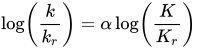
which may also be expressed as

where Δlog k represents the difference in log k value relative to the reference log kr. In this form, the relationship is a proportional one that passes through the origin, emphasizing the linear dependence between the two free energy changes.
The equilibrium constant K is determined solely by the free energy difference between the initial and final stable states and remains unchanged regardless of the reaction path. In contrast, the rate constant k depends on the reaction path and the transition state. Consequently, a simple correlation between k and K is not generally expected. Thus, a linear correlation in the REFER plot highlights the significance of linear free energy relationships.
Linear free energy relationships are often used to estimate rate or equilibrium constants since they are experimentally difficult to determine .
In the classical sense, free energy relationships establish the extent at which bond formation and breakage happen in the transition state of a reaction. Establishing free energy relationships allows us to understand the reaction mechanism. For this purpose, it is effective when combined with kinetic isotope experiments.
Although the International Union of Pure and Applied Chemistry (IUPAC) recommends the term linear Gibbs energy relationship in place of linear free energy relationship, the latter remains widely used in the literature .