Hammett equation
In organic chemistry, the Hammett equation describes a linear free-energy relationship relating reaction rates and equilibrium constants for many reactions involving benzoic acid derivatives with meta- and para-substituents to each other with just two parameters: a substituent constant and a reaction constant. This equation was developed and published by Louis Plack Hammett in 1937 as a follow-up to qualitative observations in his 1935 publication.
The basic idea is that for any two reactions with two aromatic reactants only differing in the type of substituent, the change in free energy of activation is proportional to the change in Gibbs free energy. It is important to understand, that the equilibrium constants in this relationship come from thermodynamics but the reaction rate constants come from chemical kinetics , and neither discipline predicts such relationship. Instead, it was introduced by Hammett empirically. Hammett equation belongs to a larger set of correlations between the rate of a chemical reaction and its driving force.
The basic equation is:
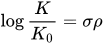
where
- = Reference constant
- = Substituent constant
- = Reaction rate constant


relating the equilibrium constant, , for a given equilibrium reaction with substituent R and the reference constant when R is a hydrogen atom to the substituent constant σ which depends only on the specific substituent R and the reaction rate constant ρ which depends only on the type of reaction but not on the substituent used.

The equation also holds for reaction rates k of a series of reactions with substituted benzene derivatives:

In this equation is the reference reaction rate of the unsubstituted reactant, and k that of a substituted reactant.

A plot of for a given equilibrium versus for a given reaction rate with many differently substituted reactants will give a straight line.

