Hölder's inequality
In mathematical analysis, Hölder's inequality, named after Otto Hölder, is a fundamental inequality between integrals and an indispensable tool for the study of Lp spaces.
Hölder's inequality—Let be a measure space and let with 1/p + 1/q = 1. Then for all measurable real- or complex-valued functions f and g on S,

![{\displaystyle p,q\in [1,\infty ]}](./_assets_/eb734a37dd21ce173a46342d1cc64c92/68ee142bd759e6d2fa264a449ed5d40d60edede7.svg)
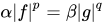
If, in addition, and and , then Hölder's inequality becomes an equality if and only if and are linearly dependent in , meaning that there exist real numbers , not both of them zero, such that -almost everywhere.
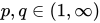



The numbers p and q above are said to be Hölder conjugates of each other. The special case gives a form of the Cauchy–Schwarz inequality. Hölder's inequality holds even if is infinite, the right-hand side also being infinite in that case. Conversely, if f is in and g is in , then the pointwise product is in .


Hölder's inequality is used to prove the Minkowski inequality, which is the triangle inequality in the space , and also to establish that is the dual space of for .

Hölder's inequality (in a slightly different form) was first found by Leonard James Rogers (1888). Inspired by Rogers' work, Hölder (1889) gave another proof as part of a work developing the concept of convex and concave functions and introducing Jensen's inequality, which was in turn named for work of Johan Jensen building on Hölder's work.