| Gamma |
|---|
|
Probability density function |
|
Cumulative distribution function |
| Parameters |
|
|
|---|
| Support |
 |
|
|---|
| PDF |
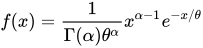 |
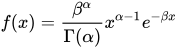 |
|---|
| CDF |
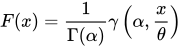 |
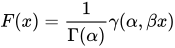 |
|---|
| Mean |
 |
 |
|---|
| Median |
Simple closed form does not exist |
Simple closed form does not exist |
|---|
| Mode |
 , ,  |
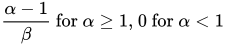 |
|---|
| Variance |
 |
 |
|---|
| Skewness |
 |
|
|---|
| Excess kurtosis |
 |
|
|---|
| Entropy |
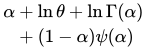 |
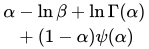 |
|---|
| MGF |
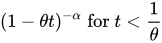 |
 |
|---|
| CF |
 |
 |
|---|
| Fisher information |
 |
 |
|---|
| Method of moments |
![{\displaystyle \alpha ={\frac {E[X]^{2}}{V[X]}},}](./_assets_/eb734a37dd21ce173a46342d1cc64c92/d348269b821bc708b396d9df854eecabce126e5c.svg) ![{\displaystyle \theta ={\frac {V[X]}{E[X]}}\quad \quad }](./_assets_/eb734a37dd21ce173a46342d1cc64c92/de7bf8b64325f4129e05929e2385f3ca37bb88bf.svg) |
![{\displaystyle \beta ={\frac {E[X]}{V[X]}}}](./_assets_/eb734a37dd21ce173a46342d1cc64c92/187bc571898043026331662ae41bb70d4104d429.svg) |
|---|
In probability theory and statistics, the gamma distribution is a versatile two-parameter family of continuous probability distributions. The exponential distribution, Erlang distribution, and chi-squared distribution are special cases of the gamma distribution. There are two equivalent parameterizations in common use:
- With a shape parameter
 and a scale parameter θ
- With a shape parameter and a rate parameter

In each of these forms, both parameters are positive real numbers.
The distribution has important applications in various fields, including econometrics, Bayesian statistics, and life testing. In econometrics, the (α, θ) parameterization is common for modeling waiting times, such as the time until death, where it often takes the form of an Erlang distribution for integer α values. Bayesian statisticians prefer the (α,β) parameterization, utilizing the gamma distribution as a conjugate prior for several inverse scale parameters, facilitating analytical tractability in posterior distribution computations.
The gamma distribution is the maximum entropy probability distribution (both with respect to a uniform base measure and a  base measure) for a random variable X for which E[X] = αθ = α/β is fixed and greater than zero, and E[ln X] = ψ(α) + ln θ = ψ(α) − ln β is fixed (ψ is the digamma function).