Fubini's theorem
Fubini's theorem is a theorem in measure theory that gives conditions under which a double integral can be computed as an iterated integral, i.e. by integrating in one variable at a time. Intuitively, just as the volume of a loaf of bread is the same whether one sums over standard slices or over long thin slices, the value of a double integral does not depend on the order of integration when the hypotheses of the theorem are satisfied. The theorem is named after Guido Fubini, who proved a general result in 1907; special cases were known earlier through results such as Cavalieri's principle, which was used by Leonhard Euler.
More formally, the theorem states that if a function is Lebesgue integrable on a rectangle , then one can evaluate the double integral as an iterated integral: This formula is generally not true for the Riemann integral (however, it is true if the function is continuous on the rectangle; in multivariable calculus, this weaker result is sometimes also called Fubini's theorem).

Tonelli's theorem, introduced by Leonida Tonelli in 1909, is similar but is applied to a non-negative measurable function rather than to an integrable function over its domain. The Fubini and Tonelli theorems are usually combined and form the Fubini–Tonelli theorem, which gives the conditions under which it is possible to switch the order of integration in an iterated integral.
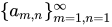
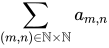
A related theorem is often called Fubini's theorem for infinite series, although it is due to Alfred Pringsheim. It states that if is a double-indexed sequence of real numbers, and if is absolutely convergent, then