Foster–Greer–Thorbecke indices
The Foster–Greer–Thorbecke indices are a family of poverty metrics. The most commonly used index from the family, FGT2, puts higher weight on the poverty of the poorest individuals, making it a combined measure of poverty and income inequality and a popular choice within development economics. The indices were introduced in a 1984 paper by economists Erik Thorbecke, Joel Greer, and James Foster.
The individual indices within the family are derived by substituting different values of the parameter α into the following equation:
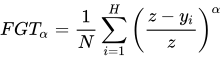
where z is the poverty threshold, N is the number of people in the economy, H is the number of poor (those with incomes at or below z), yi is the income of each individual i. When α > 0, one can also render the FGT index using positive-part notation and summing over all units:
![{\displaystyle FGT_{\alpha }={\frac {1}{N}}\sum _{i=1}^{N}\left(\left[{\frac {z-y_{i}}{z}}\right]_{+}\right)^{\alpha }}](./_assets_/eb734a37dd21ce173a46342d1cc64c92/a367df1fb541f4d7d40906dad8b396a9bd4c91cf.svg)
If is low then the FGT metric weights all the individuals with incomes below z roughly the same. The higher the value of α, the greater the weight placed on the poorest individuals. The higher the FGT statistic, the more poverty there is in an economy.
