Extremal orders of an arithmetic function
The extremal orders of an arithmetic function in number theory, a branch of mathematics, are the best possible bounds of the given arithmetic function. Specifically, if f(n) is an arithmetic function and m(n) is a non-decreasing function that is ultimately positive and
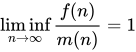
we say that m is a minimal order for f. Similarly if M(n) is a non-decreasing function that is ultimately positive and
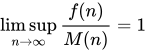
we say that M is a maximal order for f. Here, and denote the limit inferior and limit superior, respectively.


The subject was first studied systematically by Ramanujan starting in 1915.