Error exponents in hypothesis testing
In statistical hypothesis testing, the error exponent of a hypothesis testing procedure is the rate at which the probabilities of Type I and Type II decay exponentially with the size of the sample used in the test. For example, if the probability of error of a test decays as , where is the sample size, the error exponent is .


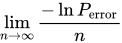
Formally, the error exponent of a test is defined as the limiting value of the ratio of the negative logarithm of the error probability to the sample size for large sample sizes: . Error exponents for different hypothesis tests are computed using Sanov's theorem and other results from large deviations theory. There are various methods used to show that an error exponent is achievable, including the likelihood ratio (which is known to be optimal in certain circumstances), and the empirical distribution. Error exponents are sometimes referred to as error rates, due to the connection between hypothesis testing and information theory.