In quantum mechanics, the Ermakov–Lewis invariant is a conserved quantity used to analyze explicitly time-dependent systems, especially the time-dependent harmonic oscillator. Because many quantum Hamiltonians are time-dependent, methods that identify constants of motion or invariants are central; the Ermakov–Lewis invariant provides such an integral of motion and underpins exact or approximate solutions. It is one of several invariants known for this system.
Let  be a function. It defines a time dependent harmonic oscillator Hamiltonian reads
![{\displaystyle {\hat {H}}={\frac {1}{2}}\left[{\hat {p}}^{2}+\Omega ^{2}(t){\hat {q}}^{2}\right].}](./_assets_/eb734a37dd21ce173a46342d1cc64c92/415755ea7570328f1e682cd828b57ea787df4199.svg)
The Ermakov–Lewis invariant for this type of interaction is
![{\displaystyle {\hat {I}}={\frac {1}{2}}\left[\left({\frac {\hat {q}}{\rho }}\right)^{2}+(\rho {\hat {p}}-{\dot {\rho }}{\hat {q}})^{2}\right],}](./_assets_/eb734a37dd21ce173a46342d1cc64c92/3dee5ab210c8382e86d1078667742f67cebcd964.svg)
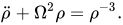
where  is a solution to the Ermakov equation
 is a unitary transformation of the time independent harmonic oscillator Hamiltonian:This allows an easy form to express the solution of the Schrödinger equation for the time dependent Hamiltonian. The exponential term
  is a squeeze operator. The other exponential term
  is a shear operator (momentum-dependent phase shift).
This approach simplifies problems such as the Quadrupole ion trap, where an ion is trapped in a harmonic potential with time dependent frequency.