Cournot competition
| Part of a series on |
| Economics |
|---|
| Principles of Economics |
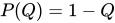
Cournot competition is an economic model describing a market where firms simultaneously compete by choosing the quantity of goods to produce and sell in the market. The stage game is one such that there are no fixed costs and constant marginal cost . The inverse demand function is . It is a static game, whereby an equilibrium is found where no firms unilaterally change their output level when the other firms produce the output levels assigned to them in the (purported) equilibrium.


This model is named after Antoine Cournot, who was inspired to develop a theoretical approach to this setting after observing firm behaviour in a spring water duopoly. The model has the following features:
- There is more than one firm and all firms produce a homogeneous product, i.e., there is no product differentiation;
- No collusion: firms do not cooperate;
- Firms have market power, i.e., each firm's output decision affects the good's price;
- The number of firms is fixed;
- Firms compete in quantities rather than prices; and
- The firms are economically rational and act strategically, usually seeking to maximize profit given their competitors' decisions.
An essential assumption of this model is the "not conjecture" that each firm aims to maximize profits, based on the expectation that its own output decision will not have an effect on the decisions of its rivals. All firms know , the total number of firms in the market, and take the output of the others as given. The market price is set at a level such that demand equals the total quantity produced by all firms. Each firm takes the quantity set by its competitors as a given, evaluates its residual demand, and then behaves as a monopoly.
