Continued fraction
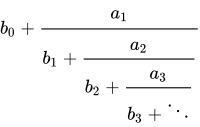



A continued fraction is a mathematical expression written as a fraction whose denominator contains a sum involving another fraction, which may itself be a simple or a continued fraction. If this iteration (repetitive process) terminates with a simple fraction, the result is a finite continued fraction; if it continues indefinitely, the result is an infinite continued fraction. The special case in which all numerators (see image) are equal to one, and all denominators are positive integers, is referred to as a simple (or regular) continued fraction. Any rational number can be expressed as a finite simple continued fraction, and any irrational number can be expressed as an infinite simple continued fraction.


Different areas of mathematics use different terminology and notation for continued fractions. In number theory, the unqualified term continued fraction usually refers to simple continued fractions, whereas the general case is referred to as generalized continued fractions. In complex analysis and numerical analysis, the general case is usually referred to by the unqualified term continued fraction.
The numerators and denominators of continued fractions can be sequences of numbers or functions.