Composite fermion
Composite fermions are electrons dressed with an even number of quantum vortices, often pictured as electrons dressed with an even number of magnetic flux quanta. They were introduced by Jainendra K. Jain in 1989, who co-received the Wolf Prize in Physics in 2025 for this contribution. Composite fermions provide a unifying theoretical framework for understanding the variety of strongly correlated quantum phases that occur when two-dimensional electron systems are subjected to strong magnetic fields.
The binding of magnetic flux quanta results in an effective reduction of the magnetic field experienced by the composite fermions, which has led to numerous groundbreaking predictions. An important prediction is fractional quantum Hall effect (FQHE) of electrons at , known as the Jain sequences, which represent the integer quantum Hall effect of composite fermions. Subsequent experiments have shown these fractions to be the prominently observed odd-denominator fractions. Fermi-liquid–like metallic states of composite fermions were predicted at even-denominator filling factors like by Bertrand Halperin, Patrick Lee and Nicholas Read, where composite fermions do not see any magnetic field. This explained why no FQHE is seen here, and was confirmed in many remarkable experiments that measure the Fermi wave vector, cyclotron orbits, etc. Just as a Fermi liquid serves as the parent state for Cooper pairing and superconductivity, the Fermi liquid of composite fermions can produce paired, superconductor-like states of composite fermions at some even-denominator fractions which results in a FQHE, as theorized by Gregory Moore and Read for 5/2 A dramatic consequence of such a state are non-Abelian quasiparticles, which are supported by thermal Hall experiments. Crystals and stripe-ordered phases of composite fermions were also predicted under some conditions and find experimental support.
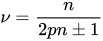

A wide range of experimental observations, including activation energy gaps, transport measurements, geometric resonance experiments, and spectroscopic probes, are readily understood in terms of composite fermions. The composite-fermion theory has been extended to make detailed predictions for spin and valley polarizations of the fractional quantum Hall states and for new states in bilayers, and continues to influence research on quantum Hall systems and related phenomena in condensed-matter physics.
Jain constructed quantum mechanical wave functions for composite fermions, which have been demonstrated to be extremely accurate and have led to quantitative predictions and confirmations of the theory. A field-theoretic treatment of composite fermions through a Chern–Simons theory was developed by Ana María López and Eduardo Fradkin, and independently by Bertrand Halperin, Nicholas Read, Patrick A. Lee, many predictions of which have been borne out by subsequent experiments.
Composite fermions also occur at zero magnetic field in twisted semiconductor bilayers or multilayer graphene, as evidenced by the appearance of the Jain sequences in these systems.