Circumconic and inconic
In Euclidean geometry, a circumconic is a conic section that passes through the three vertices of a triangle, and an inconic is a conic section inscribed in the sides, possibly extended, of a triangle.
Suppose A, B, C are distinct non-collinear points, and let △ABC denote the triangle whose vertices are A, B, C. Following common practice, A denotes not only the vertex but also the angle ∠BAC at vertex A, and similarly for B and C as angles in △ABC. Let the sidelengths of △ABC.

In trilinear coordinates, the general circumconic is the locus of a variable point satisfying an equation
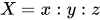

for some point u : v : w. The isogonal conjugate of each point X on the circumconic, other than A, B, C, is a point on the line

This line meets the circumcircle of △ABC in 0,1, or 2 points according as the circumconic is an ellipse, parabola, or hyperbola.
In barycentric coordinates, the general inconic is tangent to the three sidelines of △ABC and is given by the equation
