Catmull–Rom spline
Catmull–Rom spline is a special case of a cardinal spline. This assumes uniform parameter spacing. For tangents chosen to be
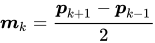
in the definition formula of cubic Hermite spline:

the following formula for the Catmull–Rom spline is obtained:
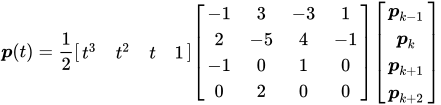
The curve is named after Edwin Catmull and Raphael Rom. The principal advantage of this technique is that the points along the original set of points also make up the control points for the spline curve.
Two additional points are required on either end of the curve. The uniform Catmull–Rom implementation can produce loops and self-intersections. The chordal and centripetal Catmull–Rom implementations solve this problem, but use a slightly different calculation. In computer graphics, Catmull–Rom splines are a common way to create smooth movement between key moments. For example, they’re often used to turn a series of camera keyframes into a fluid camera path.