Born–von Karman boundary condition
The Born–von Karman boundary condition requires the wave function to be periodic on a certain Bravais lattice. Named after Max Born and Theodore von Kármán, this periodic boundary condition is often applied in solid-state physics to model an ideal crystal. Born and von Kármán published a series of articles in 1912 and 1913 that presented this model of the specific heat of solids based on the crystalline hypothesis and included this boundary condition. Historically, the Born-von Karman boundary condition is, like the Debye model, an improvement upon the Einstein model of solids, the first quantum theory of specific heats.
The condition can be stated as

where i runs over the dimensions of the Bravais lattice, the ai are the primitive vectors of the lattice, and the Ni are integers (assuming the lattice has N cells where N=N1N2N3). This definition can be used to show that

for any lattice translation vector T such that:
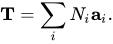
Note, however, the Born–von Karman boundary conditions are useful when Ni are large (infinite).
The Born–von Karman boundary condition is important in solid-state physics for analyzing many features of crystals, such as diffraction and the band gap. Modeling the potential of a crystal as a periodic function with the Born–von Karman boundary condition and plugging in Schrödinger's equation results in a proof of Bloch's theorem, which is particularly important in understanding the band structure of crystals.