Bondi–Hoyle–Lyttleton accretion
Bondi–Hoyle–Lyttleton (BHL) accretion (also known as Bondi–Hoyle accretion) is a mathematical model for the accretion of a uniform gas by a massive body. It is a general model of accretion with multiple applications, such as accretion of the interstellar medium by neutron stars and black holes, or wind mass transfer in binary star systems.
It is named after Hermann Bondi, Fred Hoyle, and Raymond Lyttleton. An initial estimate of the accretion rate for a supersonic wind was derived by Hoyle and Lyttleton in 1939 to explain variations in the climate of the earth. They proposed that these variations could be explained by the luminosity of the sun changing due to the accretion of interstellar material. Bondi and Hoyle showed in 1944 that, when taking some of the effects of the pressure of the gas into account, the previously derived accretion rate was only a maximum. Bondi later studied the complementary case of spherically symmetric accretion of a stationary gas (known as Bondi accretion). For the intermediate case, he proposed an interpolation formula that is now the generally accepted form of BHL accretion.
The accretion rate (the amount of mass accreted per unit of time) of the BHL formalism is given by
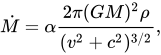
where
- is the density of the gas;
- is the relative velocity between the gas and the accreting body;
- is the mass of the accreting body;
- is the speed of sound in the gas;
- is a dimensionless factor between 1 and 2, which cannot be determined analytically.


