Bitonic sorter
Bitonic sorting network (bitonic merge sort) with 4 inputs with an example sequence that is being sorted. | |
| Class | Sorting algorithm |
|---|---|
| Data structure | Array |
| Worst-case performance | parallel time |
| Best-case performance | parallel time |
| Average performance | parallel time |
| Worst-case space complexity | non-parallel time |
| Optimal | No |

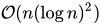
Bitonic mergesort is a parallel algorithm for sorting. It is also used as a construction method for building a sorting network. The algorithm was devised by Ken Batcher. The resulting sorting networks consist of comparators and have a delay of , where is the number of items to be sorted. This makes it a popular choice for sorting large numbers of elements on an architecture which itself contains a large number of parallel execution units running in lockstep, such as a typical GPU.

A sorted sequence is a monotone sequence---that is, a sequence which is either non-decreasing or non-increasing. A sequence is bitonic when it consists of a non-decreasing sequence followed by a non-increasing sequence, i.e. when there exists an index for which


A bitonic sorter can only sort inputs that are bitonic. Bitonic sorters can be used to build a bitonic sort network that can sort arbitrary sequences by using the bitonic sorter with a sort-by-merge scheme, in which partial solutions are merged using bigger sorters.
The following sections present the algorithm in its original formulation, which requires an input sequence whose length is a perfect powers of two. We will therefore let be the integer for which , meaning that the bitonic sorters may be enumerated in order of increasing size by considering the successive values .


