Binomial coefficient
In mathematics, the binomial coefficients are the positive integers that occur as coefficients in the binomial theorem. Commonly, a binomial coefficient is indexed by a pair of integers n ≥ k ≥ 0 and is written It is the coefficient of the xk term in the polynomial expansion of the binomial power (1 + x)n; this coefficient can be computed by the multiplicative formula

which using factorial notation can be compactly expressed as
For example, the fourth power of 1 + x is and the binomial coefficient is the coefficient of the x2 term.

Arranging the numbers in successive rows for n = 0, 1, 2, ... gives a triangular array called Pascal's triangle, satisfying the recurrence relation
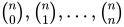
The binomial coefficients occur in many areas of mathematics, and especially in combinatorics. In combinatorics the symbol is usually read as "n choose k" because there are ways to choose an (unordered) subset of k elements from a fixed set of n elements. For example, there are ways to choose 2 elements from {1, 2, 3, 4}, namely {1, 2}, {1, 3}, {1, 4}, {2, 3}, {2, 4} and {3, 4}.


The binomial coefficients can be extended to accept more general families of inputs. When n is a nonnegative integer and k is an integer such that k < 0 or k > n, it is common to define . If k is a nonnegative integer and z is any complex number, the first multiplicative formula above can be used to define . Many of the properties of binomial coefficients continue to hold in these more general contexts.

