|
Probability mass function |
|
Cumulative distribution function |
| Notation |
 |
|---|
| Parameters |
n ∈ N0 — number of trials
 (real) (real)
 (real) (real) |
|---|
| Support |
x ∈ { 0, …, n } |
|---|
| PMF |
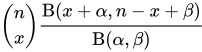
where 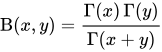 is the beta function is the beta function |
|---|
| CDF |
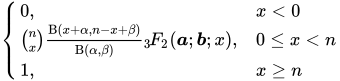
where 3F2(a;b;x) is the generalized hypergeometric function
 |
|---|
| Mean |
 |
|---|
| Variance |
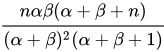 |
|---|
| Skewness |
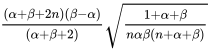 |
|---|
| Excess kurtosis |
See text |
|---|
| MGF |
 where where  is the hypergeometric function is the hypergeometric function |
|---|
| CF |
 |
|---|
| PGF |
 |
|---|
In probability theory and statistics, the beta-binomial distribution is a family of discrete probability distributions on a finite support of non-negative integers arising when the probability of success in each of a fixed or known number of Bernoulli trials is either unknown or random. The beta-binomial distribution is the binomial distribution in which the probability of success at each of n trials is not fixed but randomly drawn from a beta distribution. It is frequently used in Bayesian statistics, empirical Bayes methods and classical statistics to capture overdispersion in binomial type distributed data.
The beta-binomial is a one-dimensional version of the Dirichlet-multinomial distribution as the binomial and beta distributions are univariate versions of the multinomial and Dirichlet distributions respectively. The special case where α and β are integers is also known as the negative hypergeometric distribution.