Bendixson–Dulac theorem
In mathematics, the Bendixson–Dulac theorem is a theorem in dynamical systems that exclude the existence of periodic orbits of two-dimensional flows. Here a flow can be visualized as the surface of a pond. If you drop a leaf into a pond, it will drift according to the currents in the water, and a periodic orbit is when the leaf returns to the same place. Roughly speaking, the theorem states that if it is possible to distort the field of currents by stretching and compressing the pond like a rubber sheet, in such a way that the flow is either always expanding or always contracting, then there is no periodic orbit.
Formally, the theorem asserts that if there exists a function (called the Dulac function) such that the expression


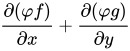
has the same sign () almost everywhere in a simply connected region of the plane, then the plane autonomous system

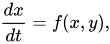
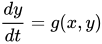
has no nonconstant periodic solutions lying entirely within the region. "Almost everywhere" means everywhere except possibly in a set of measure 0, such as a point or line.
The theorem was first established by Swedish mathematician Ivar Bendixson in 1901 and further refined by French mathematician Henri Dulac in 1923 using Green's theorem.