Alternating finite automaton
In automata theory, an alternating finite automaton (AFA) is a nondeterministic finite automaton whose transitions are divided into existential and universal transitions. For example, let A be an alternating automaton.
- For an existential transition , the automaton A nondeterministically chooses to switch the state to either or , upon reading a. Thus, behaving like a regular nondeterministic finite automaton.
- For a universal transition , the automaton A moves to and , upon reading a, simulating the behavior of a parallel machine.
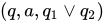


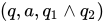
Note that due to the universal quantification a run is represented by a run tree. A accepts a word w, if there exists a run tree on w such that every path ends in an accepting state.
A basic theorem states that any AFA is equivalent to a deterministic finite automaton (DFA); hence AFAs accept exactly the regular languages.
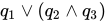
An alternative model that is frequently used is the one where Boolean combinations are in disjunctive normal form so that, e.g., would represent . The state tt (true) is represented by in this case and ff (false) by . This representation is usually more efficient.



Alternating finite automata can be extended to accept trees in the same way as tree automata, yielding alternating tree automata.